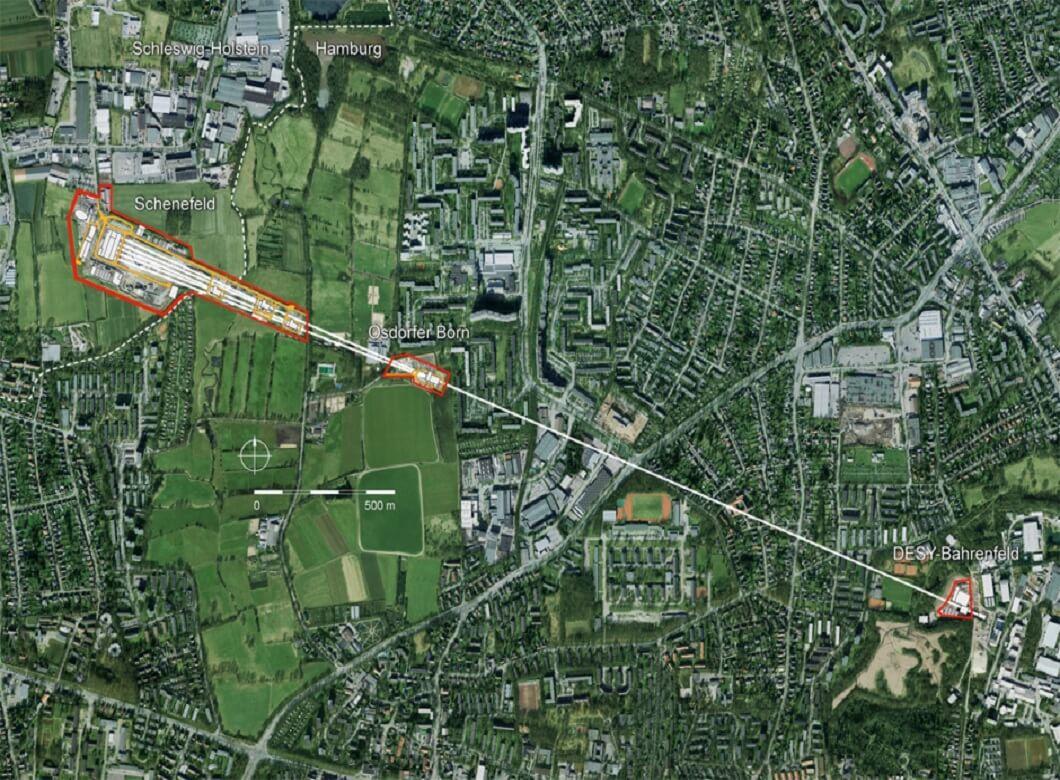
The European X-ray Free Electron Laser Installation (European XFEL) is an ESFRI infrastructure that is being built in Hamburg (Germany) and whose objective is to obtain X-rays of exceptional characteristics. The European XFEL will produce extremely bright X-ray pulses, with an instantaneous brightness approximately 1 billion times greater than that currently produced in third-generation synchrotrons such as ESRF in France or ALBA in Spain. The X-ray pulses will be ultrashort (100.10-15 s) and provided with spatial coherence, with very reduced wavelengths, in order to use them in the performance of revolutionary scientific experiments.
Representatives of ten states (Germany, Denmark, Slovakia, Greece, Hungary, Italy, Poland, Russia, Sweden and Switzerland) signed the European XFEL Convention, which constitutes a multilateral international treaty in 2009, marking the decisive start of the construction phase of the facility. On 4 February 2010, France was to join them and on 6 October 2011, the heading of the Protocol of Accession of Spain to the International Treaty of the European XFEL was held in Berlin, which will make a contribution of 1% to the total costs of construction of the facility (including preparatory phase and start-up), which will involve an investment of more than fourteen million euros.
The European XFEL aspires to become the most powerful installation of its kind; the energy of laser radiation will be in the range of X-rays, with wavelengths ranging from 0.014 to 1.6 nm.
While there are many free electron lasers operating in the world, there is still none capable of achieving such light coherence in the range of such short wavelengths. Despite the competition of some XFEL infrastructures already in operation (Linac Coherent Light Source, LCLS in the USA. US and RIKEN X-Ray Free-Electron Laser in Spring-8, SCSS, Japan) and others in design/construction phase (mainly Swiss-XFEL and Korea-XFEL), the XFEL European installation will allow to maintain Europe's leading in accelerator-based light source science and technology as it is the only one that will have superconducting technology to accelerate electrons.
Spanish participation
Almost all of the Spanish contribution to the construction phase of the XFEL will come in the form of in-kind contributions, that is, equipment of very high technological content, whose design and manufacture will require the involvement of the Spanish scientific community and various sectors of the national industry. Therefore, the acquisition of technical knowledge by Spanish companies and the associated jobs will be insured in the national territory.
The experience that can be acquired at the European XFEL will be of great interest to the Spanish laser community and the national community of synchrotron radiation users. Specifically, the photons that are going to be produced in the European XFEL have a certain relationship with those that are expected to be obtained in two national facilities: the ALBA synchrotron (built and exploited by CELLS) and the Ultra-Intense Ultra-Short Pulsed Laser Center (CLPU).
The CIEMAT is in charge of the design, development, manufacture and supply of the XFEL’s linear accelerator superconducting magnets, as well as some components of the systems called intersections. For its part, the Consortium for the Construction, Equipment and Operation of the Synchrotron Light Laboratory (CELLS) is responsible for the production and integration of the mechanical frames for the segments of the undulators, devices through which the accelerated electron pulses will be channeled. Finally, the Polytechnic University of Madrid (UPM) designs and produces a prototype power supply for the superconducting magnets of the linear accelerator of the installation and, together with CELLS, will launch the tender for the production of the complete series of sources, as well as the management of contracts with future manufacturing companies.