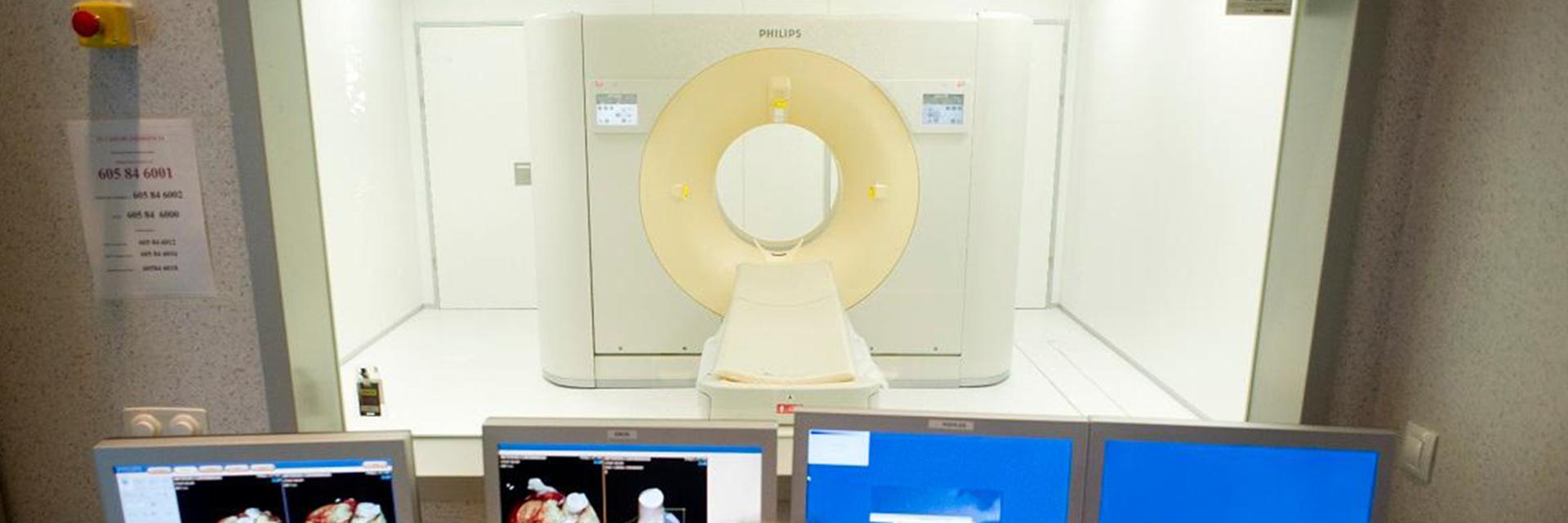
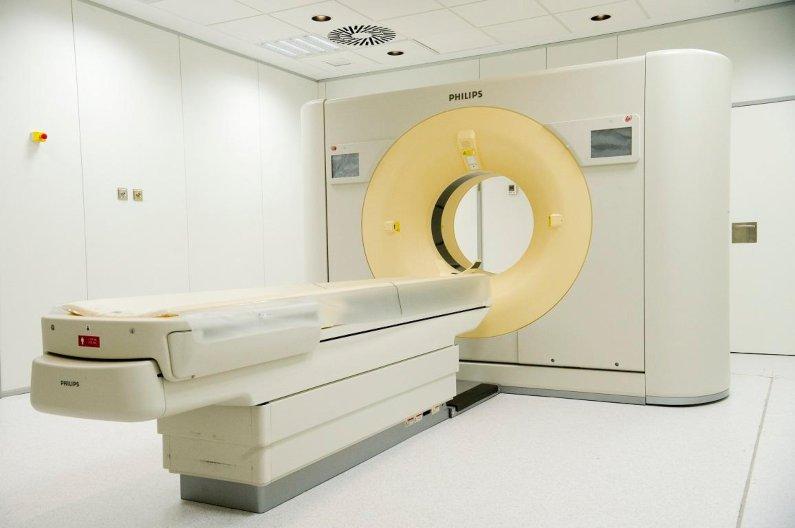
This distributed ICTS serves in the field of molecular and functional imaging, as well as in advanced and high-performance imaging.
The ReDIB consists of the following infrastructures:
Molecular and Functional Imaging Platform (CIC-biomaGUNE)
This facility is an integral part of the biomaGUNE Cooperative Research Center on Biomaterials, officially opened in 2006 and located in San Sebastian. Among other equipment, the facility features a cyclotron capable of producing a wide variety of positron-emitting isotopes, a fully equipped radiochemistry laboratory with versatile automatic synthesis modules and state-of-the-art quality control equipment, a hybrid PET-CT (positron emission tomography-computed tomography) equipment, a hybrid SPECT-CT (single-photon emission tomography-computed tomography) equipment with energy discrimination, two cameras for high-field nuclear magnetic resonance imaging (MRI) (11,7 and 7 Tesla), and a fluorescence imaging equipment. The facilities are completed with an animal farm dedicated to small rodents.
Advanced Translational Image Infrastructure (TRIMA-CNIC)
The facilities included in this infrastructure are located in the Carlos III National Center for Cardiovascular Research in Madrid and have been fully operational since 2010. They are organized on three platforms: molecular and functional imaging, advanced imaging and high performance imaging. The Molecular and Functional Imaging Unit provides optical and fluorescence microscopy services and develops new imaging applications that allow molecular details to be achieved in large samples such as whole organs and organisms as well. They also develop special applications such as large area images, cell tracking, shape recognition, multicolored images and 3D and 4D co-localization. The Advanced Imaging Unit offers state-of-the-art technologies for organ imaging with five modalities: Magnetic resonance imaging (MRI), hybrid imaging using micro-computed tomography (CT) fusion, and nuclear-positron emission tomography (PET), as well as MRI/PET, ultrasound and optics (two-dimensional and three-dimensional fluorescence and luminescence). In addition, it has a laboratory dedicated to nanotechnology and organic chemistry that produces multifunctional nanoparticles and a radiochemistry laboratory that provides radiotracers for the preclinical imaging techniques available at the center. The High Throughput Imaging Unit is a fully automated infrastructure that provides the latest technology in flow cytometry to simultaneously measure multiple optical characteristics of each of the particles or cells present in a suspension, as well as High Content Screening for the discovery of new drugs and for functional genomics approaches using siRNA libraries.
BioImage Unit at the Complutense University of Madrid (BioImaC)
BioImaC is located on the Moncloa Campus of the Complutense University of Madrid. Among its equipment dedicated to the preclinical image stands out: Magnetic Resonance Imaging equipment at three field intensities, 0.23 Tesla (open MRI for large animals), 1 T (7.6 cm in diameter, with possibility of use in self-service mode by researchers who request it), and 4.7 T (40 cm in tunnel diameter, for a wide versatility in the study of different animals, and for spectroscopy in vivo). Micro PET/CT equipment. It also has conventional radiology and fluoroscopy equipment for large animals, and ultrasound equipment, all in a veterinary hospital environment. Likewise, BioImaC has an ex vivo NMR spectroscopy service of biopsies and semi-solid matrices at 11.7 T (HR-MAS probe). Added to this is the availability of accredited facilities for the establishment of small experimental animals, as well as an agreement in force with a private company for access to 18F (cyclotron), and to radiochemical laboratories for the synthesis of PET radiotracers, thus expanding the geographical distribution in terms of availability in open access of radiotracers in different areas of the national territory.
Medical Imaging Unit of the University and Polytechnic Hospital La Fe (Imaging La Fe)
The Medical Imaging Unit of the University and Polytechnic Hospital La Fe, in Valencia, is composed of the Biomedical Imaging Research Group, GIBI230, and the Experimental Radiology and Imaging Biomarkers Platform, PREBI. Its mission is to enhance and develop the use of imaging techniques and biomarkers to optimize the diagnostic and therapeutic efficiency of medical imaging through a multidisciplinary and multimodal approach, in clinical assistance research and animal experimentation.