The Charters of Services are the documents that constitute the instruments through which the Organs, Agencies and Public Bodies and other Entities of the General Administration of the State inform the citizens and users about the services they have entrusted, about the rights that assist them in relation to them and about the commitments of quality in their provision. Its origin is linked to achieving the improvement of public services according to the demands of the citizens.
Letters of Service
Center of Attention to Citizenship (CAC)
The services of the Center of Attention to Citizenship (CAC) of the Ministry of Science, Innovation and Universities are provided through the Division of Attention to the Citizen, Transparency and Publications; attached to the Technical General Secretariat of the department.
The purposes of the CAC, in accordance with the provisions of article 6 (6.1.o, 6.1.p and 6.1.r) of Royal Decree 404/2020, of 25 February, which develops the basic organic structure of the Ministry of Science, Innovation and Universities are, the management of citizen care provided through the Administrative Information Unit (UIA) and the telematic services developed for this purpose, the functional coordination and publication of digital content on the web portal and the management of complaints and suggestions for the services provided by the Ministry, through the Complaints and Suggestions Unit.
The ACC Charter of Services expresses the will to provide its services in compliance with the commitments of quality and effectiveness specified in it.
-
Letter of services from the Center for Attention to Citizenship of the Ministry of Science, Innovation and Universities (Matrix)
PDF (ES) (1 MB) -

Letter of services from the Center for Attention to Citizenship of the Ministry of Science, Innovation and Universities (Brochure)
PDF (ES) (655 KB) -

Resolution creating the Charter of Services of the Center for Attention to Citizenship of the Ministry of Science, Innovation and Universities
PDF (ES) (187 KB) -
Follow-up report 2025
PDF (ES) (120 KB)
Center for Technological Development and Innovation (CDTI)
The Center for Technological Development and Innovation, E.P.E. (CDTI-E.P.E.) It is a Public Business Entity that promotes innovation and technological development of Spanish companies. It is the entity that channels requests for aid and support to R&D&I projects of Spanish companies at the state and international levels. Therefore, the objective of the CDTI is to contribute to the improvement of the technological level of Spanish companies. Its operation is articulated through the functions entrusted to it and established in article 3 of Royal Decree 1406/1986, of 6 June, approving the Regulations of the Center for Technological and Industrial Development and its subsequent modifications. Likewise, article 45 of Law 14/2011, June 1, on Science, Technology and Innovation, establishes the functions of CDTI-E.P.E. as a funding agent attached to the Ministry of Science, Innovation and Universities.
Through the Charter of Services, CDTI-E.P.E. It expresses the will to provide its services in compliance with the commitments of quality and effectiveness specified in it.
-
Letter of Services from the Center for Technological Development and Innovation (Matrix)
PDF (ES) (490 KB) -
Letter of Services from the Center for Technological Development and Innovation (Brochure)
PDF (ES) (747 KB) -
Resolution updating the Charter of Services of the Centre for Technological Development and Innovation
PDF (ES) (188 KB) -
Follow-up report 2025
PDF (ES) (207 KB)
National Agency for Quality Assessment and Accreditation (ANECA)
The National Agency for Quality Evaluation and Accreditation (ANECA) is the body responsible for carrying out the evaluation, certification and accreditation activities of the Spanish University System (SUE) in order to continuously improve and adapt it to the European Higher Education Area (EHEA).
Its mission is to promote and ensure the quality of the knowledge space, offering a comprehensive, national, European and international public service of social value, open to collaboration, committed to the equity and sustainability of Higher Education and Research, which includes services of information, training, guidance, consultancy, accompaniment, evaluation, certification and accreditation of teaching, research, transfer and management, contributing to its promotion, development, democratization, recognition and creation of trust in society.
-
Letter of Services from the National Agency for Quality Evaluation and Accreditation (Matrix)
PDF (ES) (644 KB) -
Letter of Services from the National Agency for Quality Evaluation and Accreditation (Brochure)
PDF (ES) (604 KB) -
Resolution updating the Charter of Services of the National Agency for Quality Evaluation and Accreditation
PDF (ES) (191 KB) -
Follow-up report 2025
PDF (ES) (77 KB)
Spanish Service for the Internationalization of Education (SEPIE)
The Spanish Service for the Internationalization of Education (SEPIE) is an autonomous agency, attached to the Ministry of Science, Innovation and Universities, responsible for the management of the European Erasmus+ programme in the fields of education and training. The agency also aims to enhance the international projection of the Spanish university system and its offer, as well as the inter-university mobility of students, teachers and researchers.
-
Letter of services from the Spanish Service for the Internationalization of Education (Matrix)
PDF (ES) (1 MB) -
Letter of Services from the Spanish Service for the Internationalization of Education (Brochure)
PDF (ES) (1 MB) -
Resolution updating the Charter of Services of the Spanish Service for the Internationalization of Education
PDF (ES) (191 KB) -
Follow-up report 2024
PDF (ES) (379 KB)
Geominero Museum
The Geominero Museum is a unit of the Geological and Mining Institute of Spain, dependent on the State Agency Higher Council for Scientific Research of the Ministry of Science, Innovation and Universities, in whose main headquarters it is located. Due to its functional dependence, it is a State-owned Museum managed by a Public Research Agency.
The objectives of the Geominero Museum are to preserve, research and disseminate the richness and diversity of the geological, paleontological and mineralogical heritage through the important collections of minerals, rocks and fossils from all Spanish regions and former colonial territories, as well as deposits signified by the world record.
-
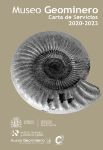
List of services of the Geominero Museum 2024-2027 (Matrix)
PDF (ES) (323 KB) -
Letter of Services from the Geominero Museum 2024-2027 (Brochure)
PDF (ES) (13 MB) -
Resolution approving the updating of the Charter of Services of the Geominero Museum 2024-2027
PDF (ES) (188 KB) -
Follow-up report 2024
PDF (ES) (447 KB)
National Museum of Science and Technology of Spain (MUNCYT)
The National Museum of Science and Technology of Spain (MUNCYT) is a state-owned museum under the General Secretariat for Scientific Policy Coordination of the Ministry of Science and Innovation and managed by the Spanish Foundation for Science and Technology (FECYT).
The mission of MUNCYT is the promotion of scientific knowledge and culture. The MUNCYT acts as a social reference and meeting point in scientific and technological matters from the consideration that each citizen has an important role to play in science and technology.
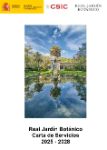
Royal Botanic Garden
The Royal Botanic Garden was inaugurated in 1781 by King Charles III at its current location, on the Paseo del Prado. Its layout and most unique elements were the work of the royal architects Juan de Villanueva and Francisco Sabatini, and among them stand out the Villanueva Pavilion, the wall, the Puerta de Murillo and the Puerta del Rey. In 1939 he became a member of the Higher Council for Scientific Research. By Decree of October 14, 1942, it was declared “Artistic Garden” and, subsequently, under Law 16/1985 of June 25 of Spanish Historical Heritage, it was ascribed to the category of “Historical and Artistic Garden”. It is included in the General Register of Goods of Cultural Interest of the Ministry of Culture with the identification code No. RI.52-0000019.
Currently the RJB is a research center dependent on the State Agency Higher Council for Scientific Research, of the Ministry of Science and Innovation, dedicated to research in plant and fungal biodiversity.
Network of Libraries and Archives of the Higher Council for Scientific Research
The Library and Archives Network of the Higher Council for Scientific Research is part of the Scientific Information System of the CSIC (SIC) and consists of the Scientific Information Resources Unit for Research and 60 specialized libraries, in addition to 14 scientific archives. The Network’s libraries are located in research centers, owned by CSIC or shared by CSIC with universities or other research organizations. The CSIC Library and Archives Network also provides library services to research staff at non-library centres and institutes through the 100% Digital Plan.
National Museum of Natural Sciences
The National Museum of Natural Sciences is one of the most important scientific research institutes in the country in the field of natural sciences. With a staff of more than 70 researchers in areas ranging from paleobiology and geology to ecology and climate change via environmental biology and biodiversity, the museum is one of the flagship centres of the Higher Council for Scientific Research (CSIC).
-
List of services of the National Museum of Natural Sciences (Matrix)
PDF (ES) (913 KB) -
Letter of Services from the National Museum of Natural Sciences (Brochure)
PDF (ES) (257 KB) -
Resolution updating the Charter of Services of the National Museum of Natural Sciences
PDF (ES) (212 KB) -
Follow-up report 2021
PDF (ES) (194 KB)
Form sent successfully. Thanks for the comment.